


Page 24 - MATINF Nr. 13-14
P. 24
24 M.N. Popescu
a
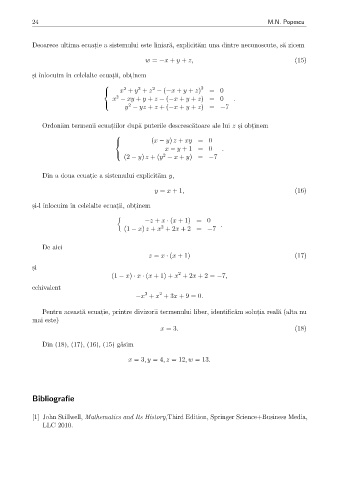
Deoarece ultima ecuat , ie a sistemului este liniar˘a, explicit˘am una dintre necunoscute, s˘ zicem
w = −x + y + z, (15)
s , i ˆınlocuim ˆın celelalte ecuat , ii, obt , inem
2 2 2 2
x + y + z − (−x + y + z) = 0
2
x − xy + y + z − (−x + y + z) = 0 .
y − yz + z + (−x + y + z) = −7
2
Ordon˘am termenii ecuat , iilor dup˘a puterile descresc˘atoare ale lui z s , i obt , inem
(x − y) z + xy = 0
x − y + 1 = 0 .
(2 − y) z + (y − x + y) = −7
2
Din a doua ecuat , ie a sistemului explicit˘am y,
y = x + 1, (16)
s , i-l ˆınlocuim ˆın celelalte ecuat , ii, obt , inem
ß
−z + x · (x + 1) = 0
2
(1 − x) z + x + 2x + 2 = −7 .
De aici
z = x · (x + 1) (17)
s , i
2
(1 − x) · x · (x + 1) + x + 2x + 2 = −7,
echivalent
2
3
−x + x + 3x + 9 = 0.
Pentru aceast˘a ecuat , ie, printre divizorii termenului liber, identific˘am solut , ia real˘a (alta nu
mai este)
x = 3. (18)
Din (18), (17), (16), (15) g˘asim
x = 3, y = 4, z = 12, w = 13.
Bibliografie
[1] John Stillwell, Mathematics and Its History,Third Edition, Springer Science+Business Media,
LLC 2010.

