


Page 19 - MATINF Nr. 13-14
P. 19
A Generalization of the Law of Cotangents                                                      19


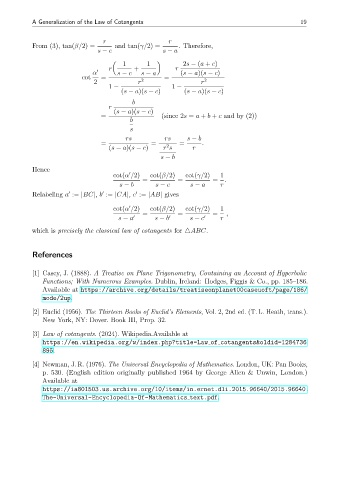
                                     r                      r
            From (3), tan(β/2) =         and tan(γ/2) =         . Therefore,
                                   s − c                  s − a
                                        Å               ã
                                            1        1           2s − (a + c)
                                       r        +              r
                                  α 0     s − c    s − a        (s − a)(s − c)
                              cot   =                      =
                                  2              r 2                    r 2
                                       1 −                   1 −
                                            (s − a)(s − c)        (s − a)(s − c)
                                               b
                                       r
                                         (s − a)(s − c)
                                    =                     (since 2s = a + b + c and by (2))
                                               b
                                               s
                                             rs            rs      s − b
                                    =                 =         =       .
                                                           2
                                       (s − a)(s − c)     r s        r
                                                         s − b

            Hence
                                              0
                                         cot(α /2)    cot(β/2)    cot(γ/2)    1
                                                   =           =            = .
                                           s − b        s − c       s − a     r
                                                 0
                         0
                                     0
            Relabeling a := |BC|, b := |CA|, c := |AB| gives
                                              0
                                         cot(α /2)    cot(β/2)    cot(γ/2)    1
                                                   =           =            =   ,
                                           s − a 0     s − b 0      s − c 0   r
            which is precisely the classical law of cotangents for 4ABC.


            References


            [1] Casey, J. (1888). A Treatise on Plane Trigonometry, Containing an Account of Hyperbolic
                Functions; With Numerous Examples. Dublin, Ireland: Hodges, Figgis & Co., pp. 185–186.
                Available at https://archive.org/details/treatiseonplanet00caseuoft/page/186/
                mode/2up.

            [2] Euclid (1956). The Thirteen Books of Euclid’s Elements, Vol. 2, 2nd ed. (T. L. Heath, trans.).
                New York, NY: Dover. Book III, Prop. 32.

            [3] Law of cotangents. (2024). Wikipedia.Available at
                https://en.wikipedia.org/w/index.php?title=Law of cotangents&oldid=1284736
                895.

            [4] Newman, J. R. (1976). The Universal Encyclopedia of Mathematics. London, UK: Pan Books,
                p. 530. (English edition originally published 1964 by George Allen & Unwin, London.)
                Available at
                https://ia801503.us.archive.org/10/items/in.ernet.dli.2015.96640/2015.96640.
                The-Universal-Encyclopedia-Of-Mathematics text.pdf.

