


Page 139 - MATINF Nr. 13-14
P. 139
˘
            PROBLEME DE MATEMATICA PENTRU CONCURSURI                                                     139

                                                                                     n

            Consider˘am funct , ia g(x) = x(n − x), x ∈ [1, n − 1]. Avem max g = g      .
                                                                                     2
                                                                            n     n
                                                                                    2
                Cum k ∈ {1, 2, . . . , n − 1}, deducem c˘ max k(n − k) = g      =     pentru n par, respectiv
                                                      a
                                                                            2      4
                                 ß Å       ã    Å       ã™      2
                                      n − 1       n + 1       n − 1
                                                                                      ˆ
            max k(n−k) = max g               , g            =        pentru n impar. In concluzie, min K n =
                                        2           2            4
            ï  2  ò
              n
                  .
              4
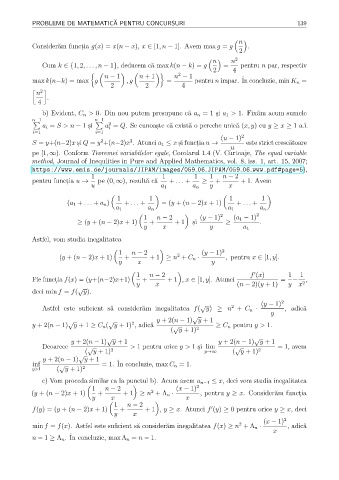
                b) Evident, C n > 0. Din nou putem presupune c˘a a n = 1 s , i a 1 > 1. Fix˘am acum sumele
            n−1                   n−1
             P                     P   2
                a i = S > n − 1 s , i  a = Q. Se cunoas , te c˘ exist˘ o pereche unic˘ (x, y) cu y ≥ x ≥ 1 a.ˆı.
                                                             a
                                                                   a
                                                                                    a
                                       i
             i=1                   i=1
                                                                               (u − 1) 2
                                    2
                                               2
            S = y+(n−2)x s , i Q = y +(n−2)x . Atunci a 1 ≤ x s , i funct , ia u →      este strict cresc˘atoare
                                                                                  u
            pe [1, ∞). Conform Teoremei variabilelor egale, Corolarul 1.4 (V. Cˆıırtoaje, The equal variable
            method, Journal of Inequlities in Pure and Applied Mathematics, vol. 8, iss. 1, art. 15, 2007;
            https://www.emis.de/journals/JIPAM/images/059 06 JIPAM/059 06 www.pdf#page=5),
                                 1                        1          1     1   n − 2
            pentru funct , ia u →  pe (0, ∞), rezult˘a c˘   + . . . +   ≥    +        + 1. Avem
                                                       a
                                 u                       a 1         a n   y     x
                                        Å              ã                       Å               ã
                                          1          1                            1          1
                         (a 1 + . . . + a n )  + . . . +  = (y + (n − 2)x + 1)      + . . . +
                                          a 1        a n                         a 1        a n
                                                  Å               ã           2            2
                                                    1   n − 2          (y − 1)     (a 1 − 1)
                            ≥ (y + (n − 2)x + 1)      +       + 1    s , i      ≥           .
                                                    y     x                y          a 1
            Astfel, vom studia inegalitatea
                                           1   n − 2                    (y − 1)
                                         Å               ã                     2
                                                               2
                      (y + (n − 2)x + 1)     +        + 1 ≥ n + C n ·           , pentru x ∈ [1, y].
                                           y     x                         y
                                                 1    n − 2                              f (x)        1   1
                                               Å               ã                          0
            Fie funct , ia f(x) = (y+(n−2)x+1)     +        + 1 , x ∈ [1, y]. Atunci                =   −  2  ,
                            √                    y      x                           (n − 2)(y + 1)    y   x
            deci min f = f( y).
                                                                       √                     (y − 1) 2
                Astfel este suficient s˘a consider˘am inegalitatea f( y) ≥ n + C n ·                  , adic˘a
                                                                                  2
                                                                     √                          y
                         √             √                y + 2(n − 1) y + 1
                                               2
            y + 2(n − 1) y + 1 ≥ C n ( y + 1) , adic˘a        √              ≥ C n pentru y > 1.
                                                             ( y + 1) 2
                                       √                                                  √
                          y + 2(n − 1) y + 1                                  y + 2(n − 1) y + 1
                Deoarece        √              > 1 pentru orice y > 1 s , i lim     √             = 1, avem
                               ( y + 1) 2                                y→∞       ( y + 1) 2
                             √
                y + 2(n − 1) y + 1
                                          ˆ
            inf       √              = 1. In concluzie, max C n = 1.
            y>1      ( y + 1) 2
                c) Vom proceda similar ca la punctul b). Acum avem a n−1 ≤ x, deci vom studia inegalitatea
                                 1    n − 2                    (x − 1)
                                Å               ã                     2
                                                      2
            (y + (n − 2)x + 1)     +        + 1 ≥ n + Λ n ·            , pentru y ≥ x. Consider˘am funct , ia
                                 y      x                         x
                                         1    n − 2
                                       Å               ã
                                                                           0
            f(y) = (y + (n − 2)x + 1)      +        + 1 , y ≥ x. Atunci f (y) ≥ 0 pentru orice y ≥ x, deci
                                         y      x
                                                                                              (x − 1) 2
                                                                                     2
                                                 a
            min f = f(x). Astfel este suficient s˘ consider˘am inegalitatea f(x) ≥ n + Λ n ·           , adic˘a
                                                                                                 x
                         ˆ
            n − 1 ≥ Λ n . In concluzie, max Λ n = n − 1.

