


Page 18 - MATINF Nr. 13-14
P. 18
18                                                                                  E.A.J. Garc´ıa


            hence
                                       cot(α/2)                     1
                                                                                    .
                                                   = p
                                    (s − b)(s − c)      (s − a)(s − b)(s − c)(s − d)
                                               »                                    cot(α/2)       1
            By Brahmagupta’s formula, ∆ =        (s − a)(s − b)(s − c)(s − d), so               =    . Cyclic
                                                                                 (s − b)(s − c)    ∆
            relabeling of a, b, c, d and α, β, γ, δ yields the other three equalities.

                Reduction to the classical law of cotangents (triangle case d = 0).

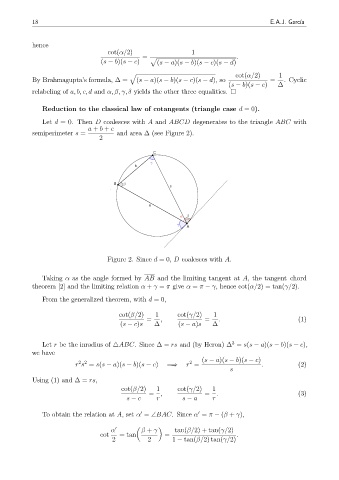
                Let d = 0. Then D coalesces with A and ABCD degenerates to the triangle ABC with
                                a + b + c
            semiperimeter s =             and area ∆ (see Figure 2).
                                    2


                                       Figure 2. Since d = 0, D coalesces with A.


                Taking α as the angle formed by AB and the limiting tangent at A, the tangent–chord
            theorem [2] and the limiting relation α + γ = π give α = π − γ, hence cot(α/2) = tan(γ/2).

                From the generalized theorem, with d = 0,

                                           cot(β/2)     1      cot(γ/2)     1
                                                    =    ,               =    .                           (1)
                                           (s − c)s    ∆        (s − a)s    ∆


                                                                                  2
                Let r be the inradius of 4ABC. Since ∆ = rs and (by Heron) ∆ = s(s − a)(s − b)(s − c),
            we have
                                                                        (s − a)(s − b)(s − c)
                                                                    2
                             2 2
                           r s = s(s − a)(s − b)(s − c)     =⇒    r =                        .            (2)
                                                                                  s
            Using (1) and ∆ = rs,
                                            cot(β/2)    1      cot(γ/2)     1
                                                     = ,                 = .                              (3)
                                             s − c      r        s − a      r

                                                  0
                                                                       0
                To obtain the relation at A, set α = ∠BAC. Since α = π − (β + γ),
                                        α 0      Å β + γ  ã   tan(β/2) + tan(γ/2)
                                    cot    = tan           =                        .
                                        2            2        1 − tan(β/2) tan(γ/2)

