


Page 34 - MATINF Nr. 13-14
P. 34
34                                                                                       V. P˘aun


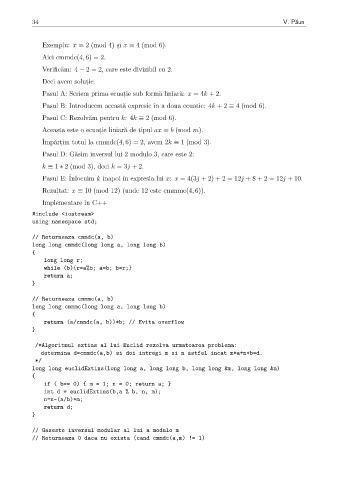
                Exemplu: x ≡ 2 (mod 4) s , i x ≡ 4 (mod 6).

                Aici cmmdc(4, 6) = 2.

                Verific˘am: 4 − 2 = 2, care este divizibil cu 2.
                Deci avem solut , ie.

                Pasul A: Scriem prima ecuat , ie sub form˘ liniar˘a: x = 4k + 2.
                                                         a
                Pasul B: Introducem aceast˘ expresie ˆın a doua ecuatie: 4k + 2 ≡ 4 (mod 6).
                                            a
                Pasul C: Rezolv˘am pentru k: 4k ≡ 2 (mod 6).

                Aceasta este o ecuat , ie liniar˘a de tipul ax ≡ b (mod m).
                ˆ
                Imp˘art , im totul la cmmdc(4, 6) = 2, avem 2k ≡ 1 (mod 3).
                Pasul D: G˘asim inversul lui 2 modulo 3, care este 2:

                k ≡ 1 ∗ 2 (mod 3), deci k = 3j + 2.
                         ˆ
                Pasul E: Inlocuim k ˆınapoi ˆın expresia lui x: x = 4(3j + 2) + 2 = 12j + 8 + 2 = 12j + 10.
                Rezultat: x ≡ 10 (mod 12) (unde 12 este cmmmc(4, 6)).

                Implementare ˆın C++
            #include <iostream>
            using namespace std;

            // Returneaza cmmdc(a, b)
            long long cmmdc(long long a, long long b)
            {
                long long r;
                while (b){r=a%b; a=b; b=r;}
                return a;
            }

            // Returneaza cmmmc(a, b)
            long long cmmmc(long long a, long long b)
            {
                return (a/cmmdc(a, b))*b; // Evita overflow
            }


             /*Algoritmul extins al lui Euclid rezolva urmatoarea problema:
               determina d=cmmdc(a,b) si doi intregi m si n astfel incat m*a+n*b=d.
             */
            long long euclidExtins(long long a, long long b, long long &m, long long &n)
            {
                if ( b== 0) { m = 1; n = 0; return a; }
                int d = euclidExtins(b,a % b, n, m);
                n=n-(a/b)*m;
                return d;
            }

            // Gaseste inversul modular al lui a modulo m
            // Returneaza 0 daca nu exista (cand cmmdc(a,m) != 1)

